

✦
Where Artistry Begins
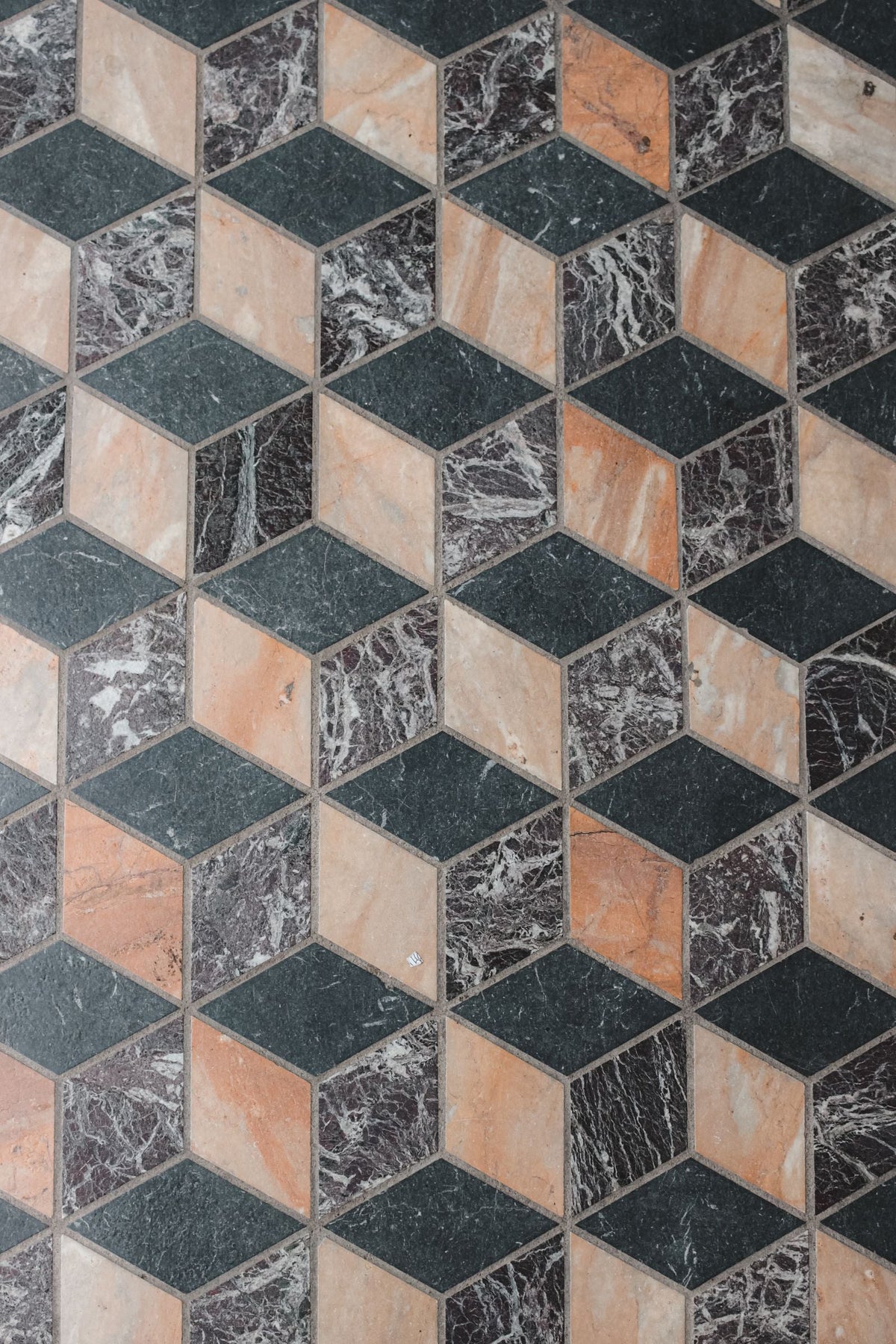
Polished plaster vs marble comes down to this: marble is stone, cut into slabs and fixed to the wall with joints; polished plaster is marble put back together, applied wet as a thin seamless coat and burnished to a stone like sheen. Both are made largely of the same mineral. The difference is format. Marble gives you the authority of solid stone and the seams that come with it. Polished plaster gives you an unbroken surface that wraps corners, columns and curves, at a fraction of the weight.
If you want it installed, our own applicators handle Venetian plaster installation from survey to final coat.
Neither is a fake version of the other. Polished plaster is genuine lime and marble; it simply is not a slab.
Marble is metamorphosed limestone, quarried, sawn into slabs and honed or polished. On a wall it is fixed slab by slab, so the design problem is where the joints fall and how well the veining is matched across them.
Polished plaster is slaked lime and graded marble powders and aggregates, trowelled on in thin coats over a primed wall and compressed with a steel trowel until the surface closes and reflects. The depth comes from the layers, not from a printed pattern. Vein work, where a wall is meant to read as marble, is laid in by hand while the material is workable. It is a skill taught on our four day advanced course, and it is why two plasterers produce two different walls from the same tub. The material itself is on the polished plaster page, and Veneziano is £200 for 24kg, tinted to your colour in the tub.
| Polished plaster | Marble slab | Marble effect tile | |
|---|---|---|---|
| Material | Lime and marble powder | Solid stone | Porcelain with a printed face |
| Format | Seamless wet applied coat | Slabs with joints | Tiles with grout lines |
| Thickness | Millimetres | Substantial | Tile plus adhesive |
| Weight on the wall | Light | Heavy, often needs engineered fixing | Moderate |
| Corners and curves | Wraps them continuously | Mitred or jointed | Cut and trimmed |
| Pattern | Unique to the wall, laid by hand | Unique to the block | Repeats across the batch |
| Repair | Patched and blended in the same material | Slab replacement, hard to match | Replace a tile if you kept spares |
| Feel | Cool, smooth, slightly soft to the touch | Cold, dense, hard | Hard, uniform, glassy |
| Floors | Not for walk on floors | Yes | Yes |
This is what clients notice first and specifiers argue about longest. A marble wall is a composition of slabs, and the joints are part of the design whether you want them to be or not. Book matched veining looks spectacular when it is done well and looks like a mistake when it is not.
Polished plaster has no joints. It runs from skirting to cornice, round a reveal, over a chimney breast and down a column without interruption. On a curved wall, a media wall with returns, or a ceiling, that continuity is not a nice to have. It is the only sensible way to get a stone look at all.
The flip side is that a seamless wall must be laid in one pass, wall by wall, holding a wet edge. You cannot stop halfway and come back tomorrow. That is a scheduling constraint marble does not have.
Stone is heavy. A marble clad wall needs a substrate and a fixing system designed for the load, and in older buildings or on stud partitions that is a structural conversation. Slab thickness also eats into the room: a lining, adhesive bed and slab together can take a noticeable bite out of a small bathroom or a narrow hall.
Polished plaster adds millimetres over the existing wall. It is one of the reasons it turns up so often in refurbishments, where the floor plan cannot afford to lose anything and the structure was never designed to carry stone.
Marble is cold and dense. Tap it and you hear stone. Polished plaster is cool but not cold, smooth with a faint give under the palm, and it takes light differently: the sheen sits in the surface rather than on top of it, so it glows rather than glares. Under low side light a polished plaster wall shows the movement of the trowel. The cloudiness that people either love or should not buy.
A printed marble effect porcelain reads correctly in a photograph and less convincingly in the room, because the pattern repeats and the face is uniformly glassy. That uniformity is exactly why it wears so well, and it is a fair trade if you want low maintenance.
We are not going to quote a rate here, because a polished plaster price depends on the wall: its size, its condition, its access, how many coats the finish needs and whether vein work is involved. What we can say is where the money goes. With marble, most of the cost is the material and the fixing. With polished plaster, most of it is labour and time on site. The material itself is modest, a tub, a primer, a wax, and the skill is the expensive part.
That has a practical consequence. A small, simple marble wall can be cheaper than you expect; a large, simple polished plaster wall can be cheaper than you expect. Complexity pushes marble up through cutting and matching, and pushes plaster up through hours. The cost drivers are set out properly in polished plaster cost in the UK.
Marble earns its place where you want unmistakable solid stone and the budget and structure allow it, and on floors and worktops, where polished plaster does not go. Polished plaster earns its place on large wall areas, ceilings, curves, columns, media walls, hallways and commercial interiors where a seamless surface is the point.
In wet areas, both need thought. A polished plaster shower wants the right material and proper protection behind it, and often the honest answer there is Tadelakt or microcement instead. For floors, plaster is the wrong tool entirely.
If what you actually want is the marble look rather than marble itself, the finish to look at is the vein worked polished plaster we cover in Venetian marble plaster. If you want something quieter and more matt, Marmorino is the same family with a stone like, lower sheen face.
Good polished plaster reads as polished stone rather than as an imitation of one specific marble. With hand laid vein work it can come very close to a veined marble, and because each wall is laid individually it does not repeat. What it will not do is reproduce a particular slab exactly, and anyone promising that is overselling.
Usually, and sometimes by a wide margin, because you are buying a thin coat and skilled labour rather than stone, transport and engineered fixings. On a large wall the gap is biggest. On a very small area the saving narrows, since most of the plaster cost is time on site rather than material.
Over sound, well fixed tiles, yes, with the right preparation and priming. We cover the method in Venetian plaster over tiles. Over polished marble it is a harder job, because a dense, sealed, non porous face gives nothing to grip. It needs proper keying and an adhesion primer, and it is not a job to improvise.
Marble, in raw terms. It is stone. But polished plaster on a wall is not under the kind of abuse that shortens a floor’s life, and it has one real advantage: it can be cleaned, rewaxed, patched and eventually recoated in the same material. A damaged marble slab usually has to be replaced, and matching it years later is difficult.
Where to go next: read the polished plaster page for the finish itself, order material and samples from the shop, and if you want a wall priced and laid by our own applicators, that is the installation page.
An outline of what limewash training covers about mixing limewash and the risks of slaking lime, and how to ask Zavoré about it.
BasementsA guide to decorative finishes for London basements, covering media rooms, gyms and wine rooms, why waterproofing must come first, and wh...
CheshireAn in depth guide to seamless microcement and tadelakt bathrooms for homes across Cheshire, and how to choose between them.
CheshireA guide to polished plaster and other decorative finishes for the large modern homes of Wilmslow and Alderley Edge, and where they fit in...
CheshireChester and the Cheshire countryside are full of timber framed, Georgian and Victorian buildings. This guide explains why lime finishes s...
Greater ManchesterHow microcement floors work in kitchen extensions across Greater Manchester, from the screed underneath to underfloor heating and everyda...

Providing luxury finishes for the most prestigious addresses in the world
Venetian plaster, limewash, microcement, tadelakt, metallics, sculptural plaster and gold leaf, supplied and installed by our own team, with Venetian plaster taught at our Birmingham studio.
One list, run by the people who make the material. No noise, and nothing we would not want to read ourselves.
We email as the house has something worth saying, never daily. Unsubscribe from any email, or reply STOP to any text. We never pass your details to anyone.