

✦
Where Artistry Begins
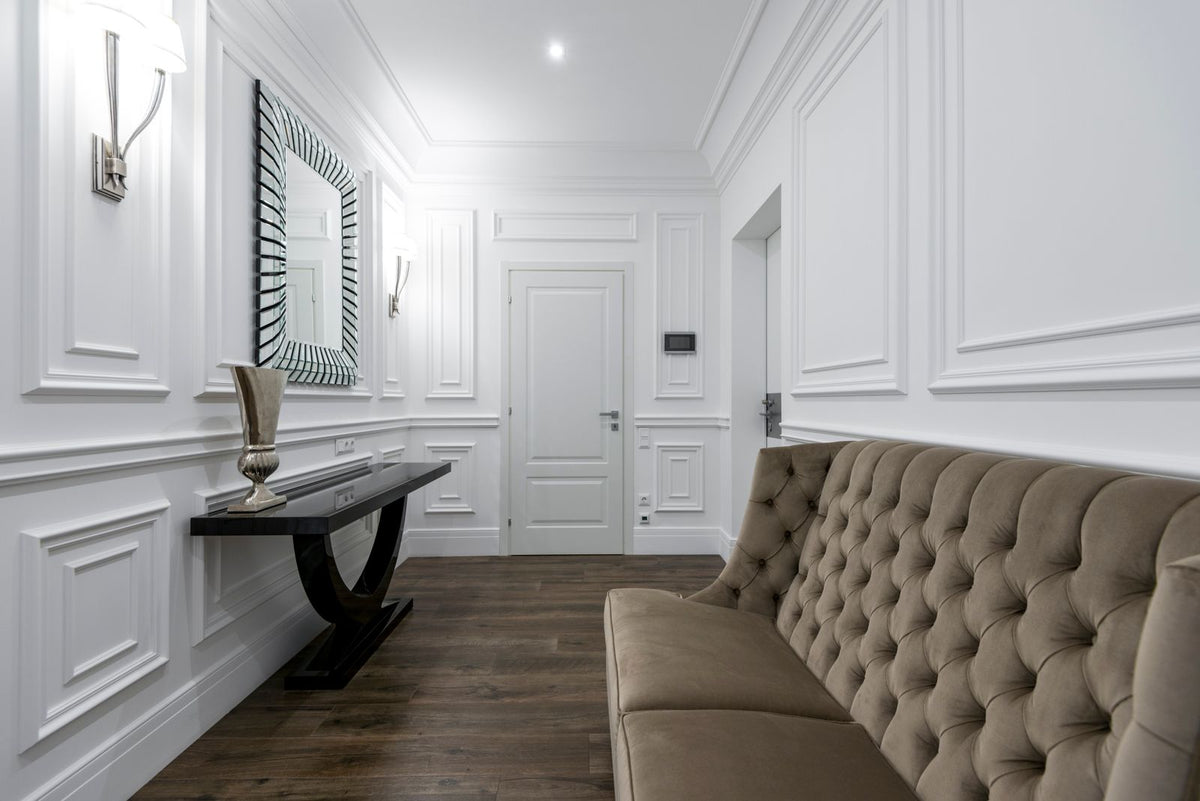
The best wall panelling ideas start with the room's proportions, not the moulding catalogue. Decide how high the panelling should go, divide the wall into panels that line up with the doors, windows and chimney breast, and choose a moulding profile that suits the age of the house. Then pick the finish, painted, limewashed or polished plaster, to set the mood. Panel mouldings applied to a plastered wall are one of the simplest ways to give a plain room real architectural character.
Zavoré lays this for you too. Our own team provides cornice and coving installation across the UK.
This guide covers panelling ideas by style and by room, how to plan the layout, and an honest comparison of plaster mouldings with timber and MDF. You can see the panel mouldings we fit and restore on our plaster cornice and coving page.

Panelled walls began as timber. In many British houses of the sixteenth to eighteenth centuries, the walls were lined with wooden panelling, and Britannica describes how the dado, the panelled, painted or otherwise decorated lower part of a wall, was common in that period. Towards the end of the eighteenth century the dado became simpler and was often marked only by a rail.
Georgian panelling was usually painted, not left as bare wood. The V&A notes that the fashion for stripped pine panelling in the 1920s was partly inspired by panelling the museum had stripped for display, and calls that taste unhistorical. Country Life, writing about early eighteenth century London houses, explains that most panelled interiors follow a hierarchy based on the classical column, with the cornice as the capital, the panels as the shaft and the dado rail as the plinth. That idea of a wall divided like a column is still the most useful starting point for any panelling scheme.
Think calm and ordered. Tall rectangular panels above a dado rail, shorter panels below, all in one soft colour. Keep the moulding profile fine and classical, and let the symmetry do the work.
Victorian rooms often carry a dado rail with a different treatment above and below it. Designing Buildings notes that towards the end of the period the dado rail became popular as a decorative device, often with wood panelling beneath. A half height scheme of panels below a rail, with a richer colour or a patterned paper above, sits naturally in a Victorian hall or dining room.
In a contemporary room, panel mouldings work best when they are simple and generous. Use a slim, plain profile, fewer and larger panels, and paint the mouldings the same colour as the wall so the panels read as shadow lines rather than decoration. Painting walls, mouldings and even the ceiling in one deep shade is a confident modern take on a traditional idea.


There is no single correct formula for panel sizes, and we would be wary of anyone who claims one. These are the checks we use when planning a wall.
MDF and timber panelling kits are widely available, quick to fit and suit a DIY weekend. MDF is stable and cheap, and timber can be shaped into true raised and fielded panels. Both are good choices in the right place, and we would not pretend otherwise.
Plaster panel mouldings are different. They are applied to a plastered wall, so moulding and wall become one surface once the joints are filled. Plaster holds a crisp, fine profile, takes paint, limewash and polished plaster beautifully, and can be repaired invisibly later. In a period house it sits naturally with the cornice and ceiling rose. The trade off is that plaster mouldings need careful fixing and finishing, which is why many people prefer to have them fitted.
For a soft, chalky look, finish plaster panels in limewash, which picks up the light differently on the moulding and the flat. For something more polished, Venetian plaster across both wall and mouldings gives depth without losing the lines.
Yes, if you keep the panels large and the profile slim. Painting the mouldings the same colour as the wall stops a small room feeling busy.
They need a sound, flat background. Loose plaster, damp or badly uneven walls need dealing with first, or the mouldings will crack or show the problem.
It should feel like the same family. A fine classical cornice wants a fine panel moulding. Our guide to Victorian, Georgian and Edwardian coving explains period styles.
Yes. We fit plaster panel mouldings with the joints filled and finished, including mouldings you have bought yourself, across the UK including London, Birmingham and Manchester.
Where to go next. See the panel mouldings, cornice and roses we fit and restore on our plaster cornice and coving page, or send us a photo and the measurements of your wall through our contact page and we will suggest a layout.
An outline of what limewash training covers about mixing limewash and the risks of slaking lime, and how to ask Zavoré about it.
BasementsA guide to decorative finishes for London basements, covering media rooms, gyms and wine rooms, why waterproofing must come first, and wh...
CheshireAn in depth guide to seamless microcement and tadelakt bathrooms for homes across Cheshire, and how to choose between them.
CheshireA guide to polished plaster and other decorative finishes for the large modern homes of Wilmslow and Alderley Edge, and where they fit in...
CheshireChester and the Cheshire countryside are full of timber framed, Georgian and Victorian buildings. This guide explains why lime finishes s...
Greater ManchesterHow microcement floors work in kitchen extensions across Greater Manchester, from the screed underneath to underfloor heating and everyda...

Providing luxury finishes for the most prestigious addresses in the world
Venetian plaster, limewash, microcement, tadelakt, metallics, sculptural plaster and gold leaf, supplied and installed by our own team, with Venetian plaster taught at our Birmingham studio.
One list, run by the people who make the material. No noise, and nothing we would not want to read ourselves.
We email as the house has something worth saying, never daily. Unsubscribe from any email, or reply STOP to any text. We never pass your details to anyone.