

✦
Where Artistry Begins
Microcement is a thin, cement based coating that is trowelled by hand over floors, walls, showers and worktops to give one continuous surface with no grout lines. It goes on in several coats, usually only a few millimetres thick in total, and is then sealed. It can go over many existing surfaces, including sound tiles, so it is often used to change a room without ripping it out. This guide explains what it is made of, where it works, where it does not, and what to ask before you commit.
Key points
Most microcement systems are a mix of cement, fine mineral aggregates, polymers or resins for flexibility and grip, and pigment for colour. The polymers are what let it go on so thin without cracking the way ordinary concrete would. Every brand has its own recipe, so always work to one manufacturer's full system rather than mixing products.
Each stage needs drying time, so a microcement bathroom takes days, not hours.
Most failures come from the surface underneath, not the microcement itself. We cover this in microcement problems and how to avoid them.
Microcement floors give one continuous surface from room to room, with no grout lines to clean and no breaks where one floor covering meets another. Because the coating is only a few millimetres thick, microcement flooring can often go over a sound existing floor, which helps where doors and kitchen units are already in place. It can also go over underfloor heating when the system allows it. Microcement flooring suits open plan kitchens and living spaces in particular, where one continuous floor running from wall to wall helps the whole space feel calm and connected.
The floor beneath must be solid and stable. Springy timber floors and damp that has not been fixed are the usual reasons a microcement floor fails, so both are checked at survey. Structural joints in the slab are carried through the finish rather than buried, and the sealer is kept up in busy areas such as kitchens and hallways. Read more in our guide to microcement floors in the UK.
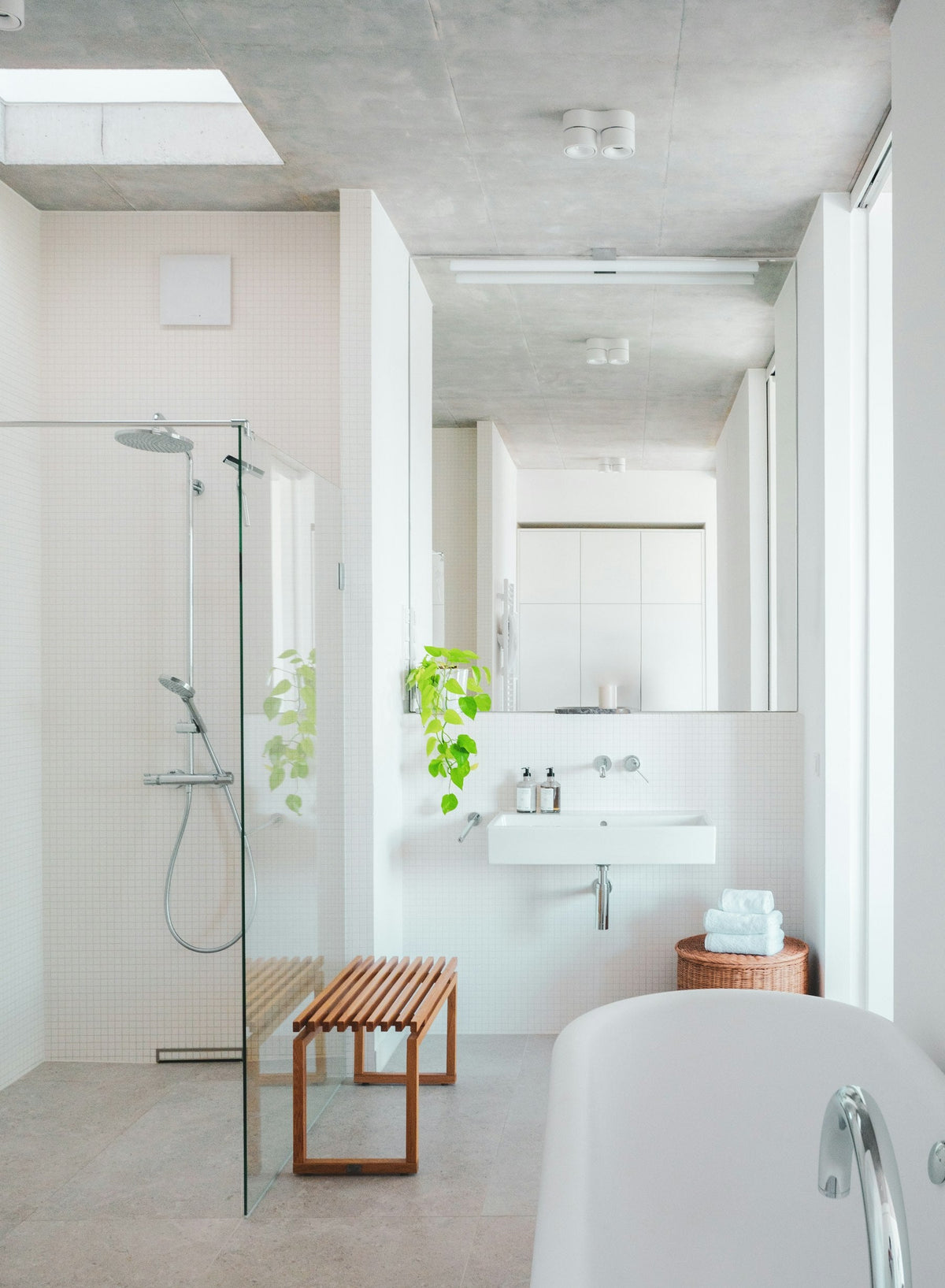
Microcement bathrooms are one of the main reasons people ask about the material. Walls, floor and shower area can share one surface with no grout, and the same finish can even carry onto baths and basins, as our guide to microcement baths and basins shows. Inside the shower, microcement goes over a waterproofing layer that is laid first, and the sealer then protects the surface from water and stains.
Lime Venetian plaster is not used inside showers, so where you want a mineral look in the wet area, microcement or tadelakt on a waterproofed wall is the choice. If you are weighing the two, read tadelakt vs microcement. Each coat needs its drying time, so plan for the bathroom to be out of use while the work is done and the sealer cures.
Microcement walls give a calm, concrete look without the weight or thickness of concrete. On walls the coating can run straight on from a microcement floor, so the whole room reads as one surface, or it can be kept to a single feature wall. It suits living spaces, kitchens, stairwells and bathrooms outside the shower as well as inside it.
If you want a similar look on walls in a breathable material, a lime finish is the other route. Real lime breathes, while a sealed system sits as a protective layer on top. Beton Stucco gives a flat concrete look in lime, and Pastellone gives a continuous lime surface for floors and walls.
One reason microcement is chosen so often is that it can go over many surfaces already in the room. Tiles that are firmly stuck, sound screeds and stable boards can all be coated, which means a bathroom or kitchen can be changed without ripping everything out. Loose tiles, hollow areas, damp and movement are dealt with first, and a reinforcing mesh is often bedded into the base coats to add strength. Our guide to microcement over tiles goes into the checks in more detail.
Microcement finishes depend on the finishing coats and how they are trowelled. The coarser base coats give strength, and the finer coats on top decide whether the surface reads as smooth and calm or shows more movement and texture. Colour comes from pigment in the mix, so it runs through the coating rather than sitting on top. See microcement colours for ideas, and always judge a shade on a sample in the room.
You will see the same material written in several ways. Micro cement and micro concrete are other names for microcement. Microcement plaster is a name some people use because it is trowelled on like a plaster, but it is cement based rather than lime based. Venetian plaster, Marmorino and tadelakt are lime plasters, a different family, which we come back to further down.
No. Polished concrete is a thick slab that is ground and polished. Microcement is a thin coating laid on top of an existing surface. The look can be similar, but the weight, thickness and installation are very different. We compare them in microcement vs polished concrete.
Lime plasters can give a similar seamless finish with a softer, more mineral feel. Zavoré stocks Pastellone for continuous lime floors and walls and Beton Stucco for a flat concrete look. If you are choosing between the two families, read Venetian plaster vs microcement.
The two are often compared, but they suit different jobs. Venetian plaster is a lime plaster with marble dust, burnished to a marble look. It breathes, it hardens slowly as the lime carbonates, and it is used on walls and ceilings but not inside showers. Microcement is a thin, cement based coating that is sealed. It covers floors as well as walls, and it can go inside a shower over a waterproofing layer.
As a rough rule, choose Venetian plaster for living rooms, bedrooms, halls and feature walls where depth and sheen matter most, and choose microcement where you want one surface across walls and floor, or where water is part of daily life. Many homes use both, each in the room that suits it.
Clear answers to these questions are a good sign. Vague answers about preparation are the one to watch, because that is where most microcement problems begin.
Microcement in the UK is a specialist finish. Each brand has its own system, each stage has to be timed, and the result depends on the surface underneath, so who lays it matters as much as what is laid. Zavoré installs microcement across the UK with our own artisans. Every job is priced after a survey, a sample is made and approved first, and the work is booked in blocks of days so the coats and drying times run in order.
To arrange a survey, see microcement installation, call +44 7592 929191 or email sales@zavore.co.uk. For a guide to what affects the price, read microcement cost in the UK.
Usually a few millimetres in total across all coats. The exact build depends on the system and the surface it goes over.
The sealer makes it water resistant, but in showers it should go over a separate waterproofing layer. See is microcement waterproof.
Kits are sold for DIY, but it is a skilled finish and mistakes are hard to undo. Read microcement kits and supplies before you buy.
Yes. Our own team lays microcement across the UK from Birmingham. See microcement installation.
Yes. Microcement for walls and microcement for floors use the same kind of system, so one finish can run across both for a seamless room.
Yes, when it is laid over a proper waterproofing layer in the shower and the sealer is kept up. That is why microcement for bathrooms is so popular.
Yes. Micro concrete and micro cement are other names for microcement.
Days rather than hours, because each coat and the sealer need drying time. The exact time is set at survey.
How microcement floors work in kitchen extensions across Greater Manchester, from the screed underneath to underfloor heating and everyda...
Buying GuideA product by product guide to the protective finishes in the Zavoré shop and which plaster each one is made for.
CommercialWhat London restaurant, bar and hotel operators should know about decorative plaster. Which finishes stand up to busy service, out of hou...
BirminghamFor people thinking about leaving another job for decorative plastering. What a beginner course at the Zavoré Academy covers, the gap bet...
TadelaktAn in depth guide to tadelakt, the polished Moroccan lime plaster, for bathrooms and wet rooms in Welsh homes, cottages and holiday lets.
DubaiHow polished plaster works on staircases and lift lobbies in Dubai villas, from tall stair walls and handrail fixings to protecting busy ...

Providing luxury finishes for the most prestigious addresses in the world
Venetian plaster, limewash, microcement, tadelakt, metallics, sculptural plaster and gold leaf, supplied and installed by our own team, with Venetian plaster taught at our Birmingham studio.
One list, run by the people who make the material. No noise, and nothing we would not want to read ourselves.
We email as the house has something worth saying, never daily. Unsubscribe from any email, or reply STOP to any text. We never pass your details to anyone.