

✦
Where Artistry Begins
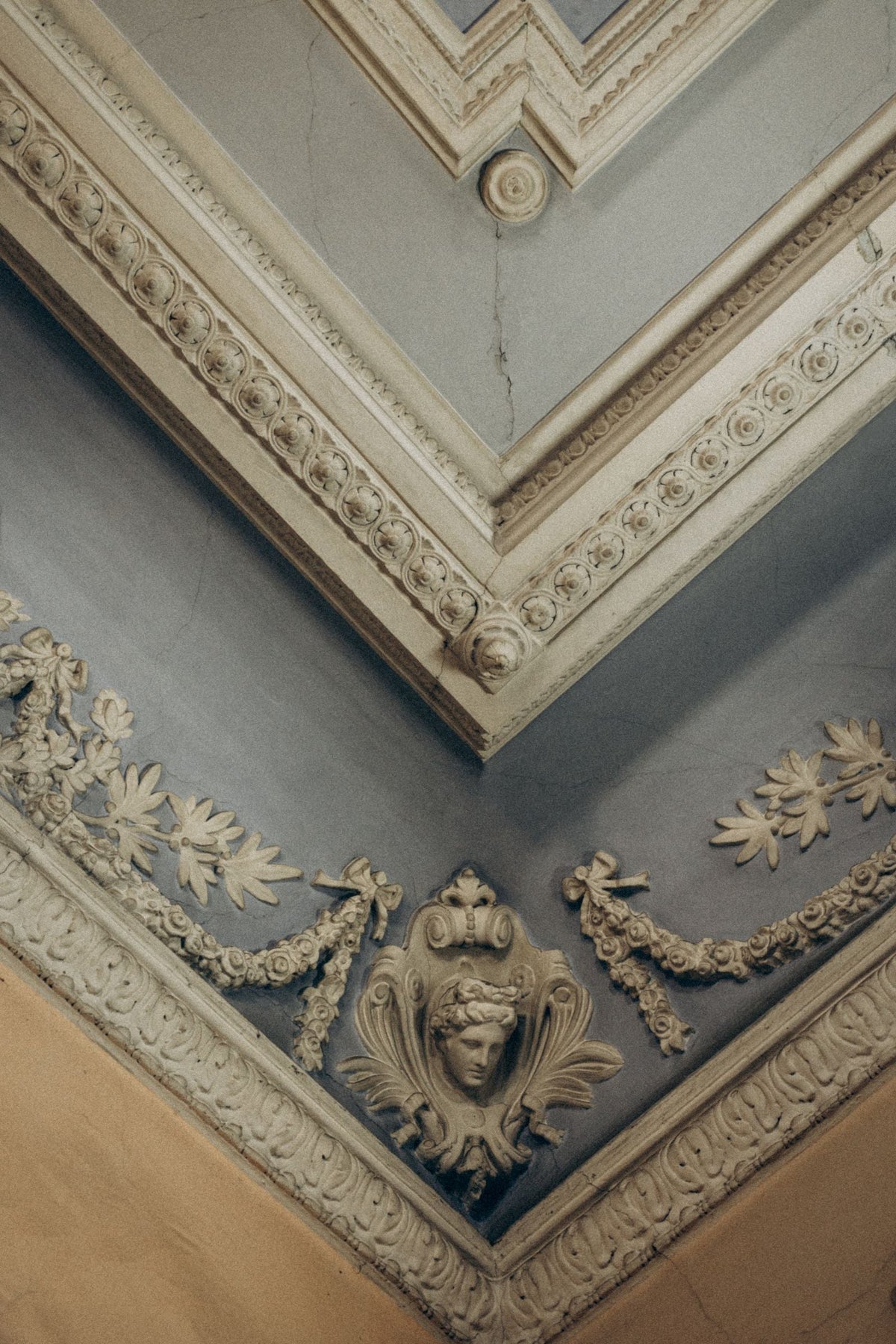
A decorative plaster ceiling can be the finest thing in a room, from a simple ceiling rose to a fully enriched Georgian ceiling. This guide covers the main styles of decorative plaster ceilings, the materials they are made from, how they are restored, and how modern methods can recreate traditional work. For new and restored plasterwork, see our plaster cornice and coving page.
Key points
Zavoré lays this for you too. Our own team provides decorative plaster installation across the UK.
Decorative plaster is plaster used for how it looks, not only to give a flat, paintable surface. It falls into two broad groups. The first is ornamental plasterwork, the moulded and cast pieces such as cornices, ceiling roses, panel mouldings, beams and central motifs. The second is decorative plaster finishes, the surfaces laid by trowel or brush, such as Venetian plaster, Marmorino, polished plaster, limewash, clay, metallics and sculpted rock.
Decorative plastering is the craft of making, fitting and finishing both. A ceiling can use one or the other, or both together, such as a restored cornice framing a ceiling finished in Venetian plaster. Our guide to what decorative plaster is covers the wall finishes in more depth.
Lime plaster was used for most historic ceilings, often on timber laths. Fibrous plaster, cast and reinforced with hessian, is used for cornices, roses and ornament. Modern plaster is used in most modern ceilings. Read types of plaster and decorative plasterwork and mouldings.
Ornamental plasterwork is the moulded side of decorative plaster. On a ceiling it usually starts at the edge with a cornice or coving, where wall meets ceiling, and works inwards. Panel mouldings divide the ceiling into sections. Plaster beams and coffers add depth. A ceiling rose sits at the centre, often around the light fitting, and enriched ceilings add swags, borders and central motifs.
The style should suit the house. A plain cornice and a modest rose belong in many Victorian and Edwardian homes, while Georgian and Regency rooms often carry finer, more delicate ornament. For help matching a profile to a period, read Victorian, Georgian and Edwardian coving and our guide to plaster ceiling roses.
A fibrous plaster ceiling uses plaster cast in moulds and reinforced with hessian, so each piece holds its shape. Cornices, roses and ornament are cast in lengths or sections and then fixed in place, with the joints filled and finished so they read as one. Because the pieces come from moulds, a missing section can often be recast to match from a surviving one.
Fibrous plasterwork on an older ceiling should be checked for loose fixings and cracks, just like the plaster around it. If a piece has dropped or shows signs of moving, have it assessed by a specialist before it is painted over.
New moulds can be made by scanning or measuring an existing profile and cutting it by CNC, then casting matching pieces. This lets a new extension or a restored room match the original plasterwork. See CNC moulds and mouldings.
A decorative plaster ceiling does not have to be historic. In a modern home or a new extension, a clean cornice or a simple coving can frame the room without fuss. A Venetian plaster ceiling gives a smooth sheen that moves with the light through the day, which can lift a hall, a stairwell or a dining room. Limewash gives a soft, chalky ceiling that suits calm bedrooms. Gilding can pick out a single rose or border for a touch of richness.
Where a new extension joins an older house, CNC cut moulds let the new cornice match the original exactly, so the two rooms read as one. Pair a decorative ceiling with a feature wall in the same palette and the whole room comes together.
Most of the care a plaster ceiling needs is about not harming it. Layers of paint build up over the years and clog the fine detail of a cornice or rose, so each repaint should be thin, and old build up should be removed carefully by a specialist rather than scraped off by hand. A specialist can also tell you whether a crack is only on the surface or a sign that the plaster is coming away from the laths. Keep an eye on the ceiling after any work in the room above, such as new flooring or plumbing, and look again at any crack that grows or changes shape.
On a lime ceiling, choose finishes that let the lime breathe, such as limewash or a mineral paint, rather than a product that forms a film. A Venetian plaster ceiling is protected with a wax or sealer and needs little more than a gentle dust.
Zavoré was established in 2021 and installs, supplies and teaches Venetian plaster and decorative finishes. For ceilings, our own artisans handle cornice and coving installation, plaster mouldings and Venetian plaster ceiling finishes. Every job is priced after a survey, a sample is approved first, and the work is then booked in blocks of days so it runs straight through.
Decorative finishes come in 48 house colours or any NCS colour. If you want to learn the craft, the Zavoré Academy in Birmingham, with centres in London and Manchester, runs every course at all three, from the 3 day Beginner course and the 4 day Advanced course to 3 days of 1 to 1 Training, with materials included. You can also see finishes at our London showroom and training centre by appointment. See our decorative plastering courses. To talk through a ceiling, call +44 7592 929191 or email sales@zavore.co.uk.
See our cornice, coving and mouldings service.
Historically lime plaster, with fibrous plaster for ornament. Modern ceilings are usually ordinary plaster with fibrous mouldings fixed on.
Often, yes, if it is assessed early. Cracks and sagging should be assessed by a specialist.
Often, by taking moulds or profiles from surviving sections.
Decorative plaster is plaster used for its look. It covers ornamental plasterwork, such as cornices and ceiling roses, and decorative finishes, such as Venetian plaster, polished plaster and limewash.
The main types are lime plaster, fibrous plaster and modern plaster for the ceiling itself, and finishes such as Venetian plaster, polished plaster, limewash and gilding laid over it.
Yes. Cornices, roses and mouldings are still cast in fibrous plaster, from traditional moulds or from CNC cut moulds that copy an existing profile.
It is a ceiling whose ornament is cast in moulds from plaster reinforced with hessian, then fixed in place. Cornices and ceiling roses are often made this way.
Yes. Venetian plaster can be laid on a sound, flat ceiling for a smooth sheen. See Venetian plaster ceilings.
Yes. Our own artisans install cornice, coving and decorative finishes, priced after a survey.
How microcement floors work in kitchen extensions across Greater Manchester, from the screed underneath to underfloor heating and everyda...
Buying GuideA product by product guide to the protective finishes in the Zavoré shop and which plaster each one is made for.
CommercialWhat London restaurant, bar and hotel operators should know about decorative plaster. Which finishes stand up to busy service, out of hou...
BirminghamFor people thinking about leaving another job for decorative plastering. What a beginner course at the Zavoré Academy covers, the gap bet...
TadelaktAn in depth guide to tadelakt, the polished Moroccan lime plaster, for bathrooms and wet rooms in Welsh homes, cottages and holiday lets.
DubaiHow polished plaster works on staircases and lift lobbies in Dubai villas, from tall stair walls and handrail fixings to protecting busy ...

Providing luxury finishes for the most prestigious addresses in the world
Venetian plaster, limewash, microcement, tadelakt, metallics, sculptural plaster and gold leaf, supplied and installed by our own team, with Venetian plaster taught at our Birmingham studio.
One list, run by the people who make the material. No noise, and nothing we would not want to read ourselves.
We email as the house has something worth saying, never daily. Unsubscribe from any email, or reply STOP to any text. We never pass your details to anyone.