

✦
Where Artistry Begins
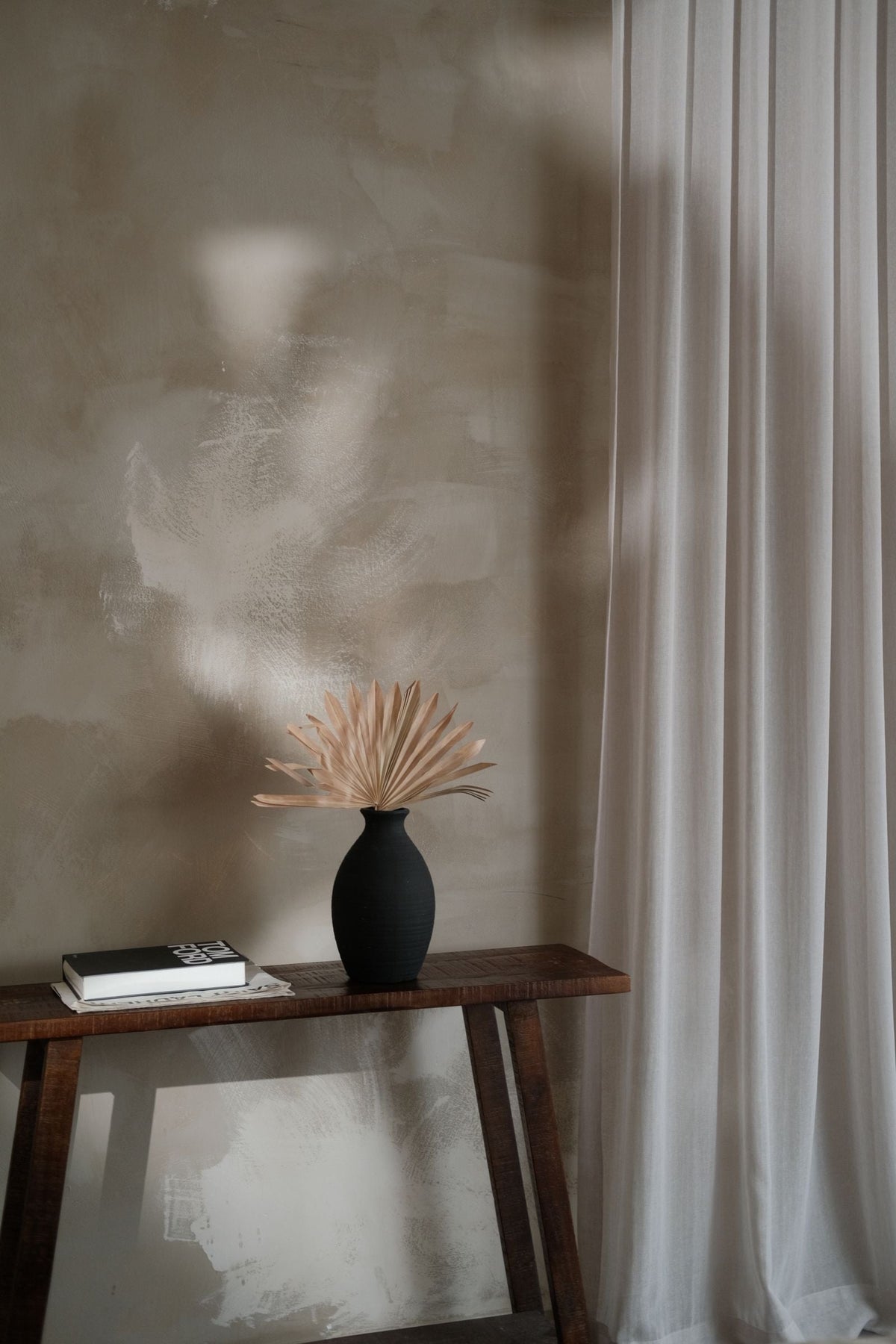
A Venetian plaster feature wall is a single wall finished in decorative plaster while the rest of the room stays plain, and it is the most common way people start with the material. The right wall is usually the one you see first as you enter, or the one behind the bed or sofa, and it should catch light from the side. A single wall is a small job in area but not a small job in setup, so it costs more per square metre than a whole room. This piece covers choosing the wall, colour, edges, corners and cost.
If you want it installed, our own applicators handle Venetian plaster installation from survey to final coat.
The wall that works best is not always the obvious one. Ask three questions.
Good candidates are the wall behind a bed, the wall behind a sofa, a chimney breast, the end wall of a hallway, and the wall behind a dining table. A wall full of doors, sockets and switches is usually a poor one, because every cut out breaks the surface.
A feature wall exaggerates whatever is behind it. Grazing light that makes the plaster look deep will also pick out every bump, patch and wave in the wall. Before any decorative finish, the wall must be sound, dry, flat and primed. If it is not, that is put right first and is a separate job.
Small things matter more on a single wall than across a whole room. Sockets and switches can often be moved or replaced with flat plates before we start. Radiators are best taken off the wall so the finish runs behind them. Picture hooks and fixings should be planned in advance, because drilling a finished polished wall later is possible but never as neat.
Most feature walls are one working surface with two edges, a ceiling line and a skirting. That is a manageable size for one applicator. The finish goes on in several thin coats, with drying time between them, so even a single wall is spread over more than one visit. Setting up, protecting the room, masking the edges and clearing down take much the same time whether the wall is small or large.
For a DIY project, a single feature wall is the right size to start with. It lets you learn the finish on a surface where a small mistake is contained. Order a sample board first and practise the stroke on it before you touch the wall. Our coverage guide will help you work out how much material the wall needs.
A feature wall is judged against its neighbours, so choose its colour with the other walls in view. There are three safe approaches.
Plaster colour moves more than paint colour. It looks lighter wet and darker under wax, and a trowelled surface shows variation that a paint swatch cannot. Look at a real sample on the wall itself, in daylight and in the evening. Our colour range is the place to start, and choosing colour for Venetian plaster goes further.
Edges make or break a feature wall. Because the finish stops where a neighbouring wall carries on in paint, every edge is on show.
| Edge | Our usual approach |
|---|---|
| Internal corner | Stop the plaster exactly at the corner with a crisp, masked line. The neighbouring wall is painted up to it. |
| External corner | Wrap the finish round the corner to the next natural stop, or stop on the corner with a clean edge. A half wrapped corner looks unfinished. |
| Ceiling line | A straight masked line at the angle. If there is a cornice, stop at its lower edge. |
| Skirting | Take the plaster down to the skirting top. Skirtings are painted before the plaster goes on, with care to protect them after. |
The order of work matters. We normally paint the neighbouring walls first, then mask and lay the plaster, so the final edge is the plaster edge. That gives the cleanest line.
Polished plaster is the classic choice: a deep, marble like surface that can be burnished from satin to high gloss, and the finish most people picture when they search for a Venetian plaster wall. Marmorino gives a softer, stone like look. A metallic or artificial rock finish is more dramatic and suits a wall designed to be the one strong statement in the room. Each has its own page in our range, and a sample board shows the difference faster than any photograph.
We do not give a single price for a feature wall, because the wall itself decides it. What we can say is how the cost behaves.
Doing it yourself cuts the labour but not the need for patience. For the numbers behind a professional quote, see polished plaster cost in the UK.
Usually the wall you face as you enter, or the wall behind a bed, sofa or dining table. It should catch light from the side, from a window or wall lights, so the depth of the plaster shows. Avoid walls crowded with doors, sockets or shelving, because each interruption breaks the finish and hides the work.
In most rooms, yes. One wall in a well chosen colour gives the room a focal point without making it feel heavy. Plaster on every wall suits some rooms, particularly bedrooms, hallways and dining rooms, but a single wall is the easier decision and the natural place to start if you are unsure.
Not necessarily. A few shades deeper in the same colour family is the safest route. The same colour in a different finish is quieter and often more elegant, because the texture and sheen alone make the difference. A strong contrast works well, but it needs furniture and fabrics in the room to support it.
Many people do, and a single wall is the right size to learn on. Practise on a sample board first, get the wall flat and primed, and keep your edges masked. If you want to learn properly, our Academy courses teach polished plaster and marmorino from bucket to burnish.
Where to go next: order a sample board in the colour you are considering and hold it against the wall in morning and evening light. Browse the colour range, then the shop for material, or ask our installation team to lay it for you.
An outline of what limewash training covers about mixing limewash and the risks of slaking lime, and how to ask Zavoré about it.
BasementsA guide to decorative finishes for London basements, covering media rooms, gyms and wine rooms, why waterproofing must come first, and wh...
CheshireAn in depth guide to seamless microcement and tadelakt bathrooms for homes across Cheshire, and how to choose between them.
CheshireA guide to polished plaster and other decorative finishes for the large modern homes of Wilmslow and Alderley Edge, and where they fit in...
CheshireChester and the Cheshire countryside are full of timber framed, Georgian and Victorian buildings. This guide explains why lime finishes s...
Greater ManchesterHow microcement floors work in kitchen extensions across Greater Manchester, from the screed underneath to underfloor heating and everyda...

Providing luxury finishes for the most prestigious addresses in the world
Venetian plaster, limewash, microcement, tadelakt, metallics, sculptural plaster and gold leaf, supplied and installed by our own team, with Venetian plaster taught at our Birmingham studio.
One list, run by the people who make the material. No noise, and nothing we would not want to read ourselves.
We email as the house has something worth saying, never daily. Unsubscribe from any email, or reply STOP to any text. We never pass your details to anyone.